Geeky stuff posting
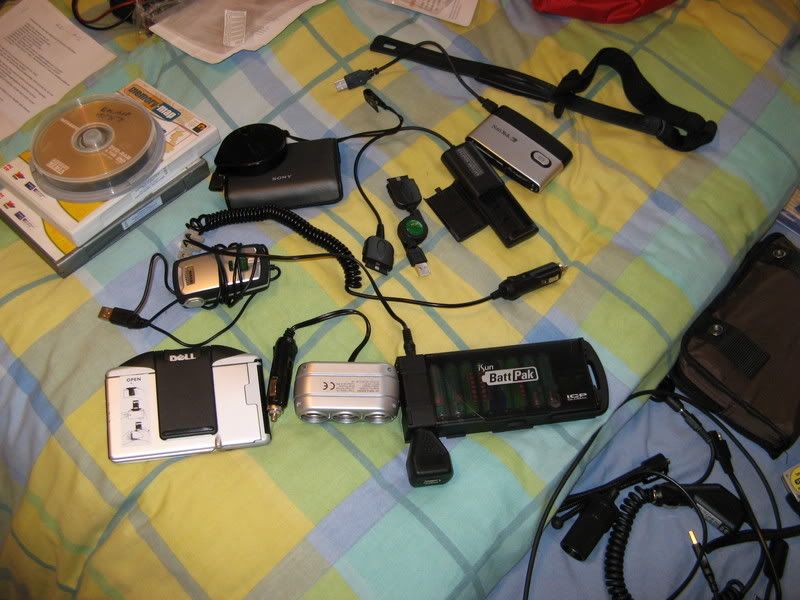

No excuses, just a pure geek posting. Some people are very interested in using the latest mobile technology, and some are anything but and like to keep it simple when touring. The latter say that the ‘stress’ of looking after vulnerable equipment and not least keeping it charged up, are not worth the bother, and that it detracts from the simplicity of cycling, enjoying the ride etc. I think I must sit over towards the side of the former for various reasons, but not least in that I love the idea of keeping a current blog without having to sit in a mucky internet café for many hours a week (these can be expensive too, although there are many libraries and Telecentres in Australia that offer free surfing / e-mail). Also, one MUST have a decent camera, and a mobile phone for emergency etc., so it’s hard to avoid thinking Geek in 2007 – much of it is pretty much essential! Convinced? (;>)
I would prefer to type up my blog anytime I like though, such as in the evening, so I have pulled the following gear together to help with this and several other technological ‘requirements’. Here is a lengthy discussion about my inventory, strictly for geeks:
Dell Axim X51V PDA – the heart of the ‘system’, a miniature PC that can do just about whatever a PC can, such as write Word documents and Excel spreadsheets, store and play music aka MP3 player, act as a GPS in conjunction with a GPS receiver and software maps of Australia, play computer games (not very often in my case apart from Sudoku), act as a dictaphone; and surf the internet either and send e-mails via a wireless connection or via a bluetooth mobile phone acting as a modem. I won’t get much opportunity to do the latter in the Outback of course, however I can compose my e-mails offline (including the e-mail required to update this blog) when I like, and then download at telecentres or cafes. The Axim normally communicates to my home PC via Microsoft Activesync, however this probably won’t be available on the PC’s I find in Oz, so an alternative is to simply use a card reader – more on this next.
I use Textmaker as a word processor as it every bit as powerful as the PC version of MS Word. I have an extensive Excel spreadsheet loaded too, which contains all the information I’ve collated with respect to this trip – such as a list of all my gear, places to see, useful website links etc. All this stuff will be backed up onto an SD card.
Whenever there’s a Wireless network (OK, I won’t find many Starbuck’s as I go around Australia!!) I can use the Axim to access the internet and send e-mails, and I will also put it’s Bluetooth capabilities to the test too, as explained below.
Dell Portable Bluetooth KeyboardThis is only about 15x10 cm and very light, but when unfolded is almost as big as a conventional keyboard. It uses very little power and needs only 2 x AAA batteries to power it. As soon as I switch it on, and switch Bluetooth on on the Axim, the two pair up with no fuss and I can start typing away.
SD and CF Storage Cards
The Axim is very flexible in that it can accept both SD (Secure Digital) and CF (Compact Flash) storage cards. The former range up to 4GB in size (sufficient for 3 to 4000 high-quality images for example) at approximately £25 each (in July 2007); whereas the CF’s currently go up to a massive 16GB (but these cost around £120!!). The 2 or 4GB SD’s are what I will probably choose – for one thing I don’t want a high-capacity card to hold all my pictures because that’s putting all my eggs in one basket – lose the card, lose everything. I’ll find a nice dry container to keep all the cards in and keep it somewhere safe.
As I said above I will use the cards to transfer e-mails, Word files, images etc. to the host PC (in an Internet café or Telecentre) using a simple SanDisk card reader like this one. This can accept both SD and CF cards, so I just have to remove the card from Axim or camera, pop it into the reader, plug the USB lead into the host PC, find the card in File Explorer, and drag and drop the files into an e-mail, temporary folder etc. for e-mailing, burning CD’s etc.
I could also download music or files from the internet onto the card, for later transfer back into the Axim to read at my leisure.
Globalsat BT338 GPS receiver
This pairs with the Axim via Bluetooth up to a range of 10 metres and amongst other things shows me where I am on the Memory-Map Austour maps – most of which are a decent 1:250,00 scale. The maps contain important information like water points and shops, things to see etc., and I can add my own Points of Interest (POI’s) too where necessary. I have been listing things I’d like to see – from books and blogs I’ve read – for some time, and I will mark these on the maps. This is best done on the PC before I leave UK, foe use on the Axim thereafter. I wasn’t too excited about the Axim as GPS unit when I toured the Alps last July, however I have obtained some high-quality transparent screen protectors that cut out a lot of the glare, so I am more optimistic. I also had battery charging problems in the Alps which are hopefully sorted out now.
Canon A710 IS compact digital camera
This seems to be a very capable camera that ticks all the boxes at well under £200. It accepts SD cards which is fundamental to my ‘system’; since the Axim accepts SD’s I can transfer the images from camera to Axim, and also take advantage of the Ax’s great display to view and sort the images. I’ll be restricting the SD card size to 1 or 2GB I think since these are quite cheap, hold around 750 / 1500 pics each, and by using smaller cards the risk of losing a card and ALL my pics is reduced. In reality I will be taking film clips with this camera too, and that takes a bit more card space – I think around 1 hour of video (at good quality) per 2GB card. Whenever I get the opportunity I will be transferring the pics onto CD as backup. Some travellers even more geeky than I carry a portable CD/DVD burner around with them – you can now apparently get these that run on 4xAA batteries – but that’s a bit OTT methinks. I’m quite geeky enough thank you!
I’ve been right through the camera manual and found some other good features, such as the ability to record up to a minute of speech associated with each image one takes – a description of what the pic is about etc. It’ll be fun putting all this into a video / slide show on my return to Blighty.
Mobile Phone
I haven’t bought the phone I need for Oz yet, and at first I thought I’d buy it once over in Perth, together with a suitable package / SIM card, however I think I will buy one before I go with a pay-as-you-go SIM and get used to using it – especially as a modem with the GPS. In modem mode the phone pairs with the Axim via Bluetooth and where there is a mobile signal I can e-mail or surf the web with the Axim. This is something of an ‘emergency’ option for when there’s no other internet access, especially because it’s pretty expensive on what could be a slow connection for most of the Oz mobile network – a little bit faster where there’s 3G reception (mostly in cities). (so a Tri or Quad-band phone required.) I can probably pick up something on Ebay for £30 or £40 that will do the trick. Another quality that would be useful is ruggedness – it needs to be able to survive a few knocks.
Another desirable mobile phone feature is use of mini or micro SD cards – these are compatible, via an adaptor, with SD cards used in the Axim and camera – to aid interconnectivity. The micro SD’s are much smaller than a postage stamp yet can hold 4GB of data too – a staggering thought. How we’ve moved on since I bought my first computer – a BBC B with 32 kB processor!
Skype microphone / speaker
I may get to use this on any PC connected to the internet, a cheap think off Ebay which also happens to be a mouse as well.
Bicycle computer
I’ve splashed out on a £200 Garmin Edge 305 (well, don’t carp at me - this is the trip of a lifetime and I’ve been saving, frugally, for ages, honest!!). This will give me (for example – there are about 40 functions!) speed, distance, position, direction of travel, elevation, cadence, heart rate and most of the usual GPS features apart from map displays. It does however show a ‘map’ of created waypoints in correct orientation, which is all that’s needed. There is of course also the possibility of geekishly downloading this data for later analysis lol. Only downside is the relatively high power consumption – it will have to be charged after every 2 days riding, which takes about 3 hours. I quite like having good instrumentation and for me it adds to the overall experience of cycling. It also has a proper altimeter rather than just depending on GPS, which is less accurate at heights.
I also have another wireless computer that I am taking as a back-up, just in case the Garmin fails.
Solar charging system / supporting system
I’ve covered this in depth in an earlier posting, but essentially it will consist of two Sunlinq 6.5 watt foldable panels (they fold neatly into the size of a paperback novel) feeding a bank of AA batteries (the BattPack). AA batteries are the ‘standard’ I have chosen to power my camera, Axim (via a 4xAA battery ‘extender’), torches etc. The BattPack can charge between 2 and 10 batteries at a time, fed by the 12 to 15 volts from the panel (or 2 panels in parallel when needs must). I’ve done some tests and was slightly disappointed with the performance of the panel – I think the ‘claims’ of the makers was slightly exaggerated – and so decided to go with the two rather than one. I’ve found in bright sunshine fully 15 volts is generated, and the BattPack automatically adjusts the voltage to suit between 2 and 10 batteries. I think that on any day without blazing sunshine 4-8 batteries is a better option – the 10 AA’s would take a long time to charge, especially the 2600 mAH high-performance batteries that I have obtained. I haven’t tested the 2 panels together yet, but plan to do this soon. I also plan to measure the current, to get a better idea of how quickly the batteries should charge up.
Now the BattPack has a car cigar-type female socket outlet, which is very convenient for gadgets that come with a car charging lead, such as a phone. Devices like this and the Axim need around 4 to 5 volts so at least 4 batteries would need to be fitted. Of course the charge lead for a particular device will be set to deliver the correct voltage, you just need to make sure to exceed that. For fastest charging all 10 batteries would be best if already charged up.
I have further alternative options based on the AA’s and car socket – for example a car charger with USB female socket for charging the Axim, camera and bike computer directly; and a 230V mains (and Oz mains adaptor) charger to charge a bank of 10 batteries in one go for use when I’m staying where there’s AC supply. I can also charge the BattPack of 10 in a friendly campervan if pushed via a normal (male) car plug, and if all else fails I can buy a bank of non-rechargeable AA’s for the BattPack (don’t aim to do this due to cost). And there’s more – I will also be able to charge my camera and Axim with the USB lead plugged into a PC at Internet café or Telecentre / library. The camera and bike computer can both be charged using the same mini USB to USB lead that came with these devices, and some of the other leads have a degree of interchangability about them – useful if a lead breaks for example.
Lastly, I have a 1 to 3 car charger adaptor whereby I plug the male end in the BattPack and up to 3 other leads (subject to power being used) into the adaptor.
The Axim takes the most power, only about 3 hours on the standard 1100 mAH battery, but I also have a 2200 mAH spare. I can’t see me using the Ax for more than a couple of hours
All the above is subject to rigorous testing in Outback conditions – hopefully I have invested sufficiently in robust components – but I will post in this blog details of how I get on, hopefully others might learn from any mistakes I have made.
Short-wave radio
I did some research on the lightest SW radio (good for updating weather / news / the Archers etc.) and came up with the Sony ICF-SW100, an absolute gem of a radio. Build quality is very high, and power consumption low. I managed to get this one second hand for around £60 on Ebay – full price is (was? I think Sony may not make them any longer) around £200, and it’s easy to see why. It came with an aerial ‘reel’ that can be unwound and clipped in a tree or somewhere higher up, to increase signal strength. Enough to make a true geek drool.


